A tomato plant's primary goal isn't to feed you; it's to create more tomato plants. If you let it go completely wild, it will spend all of its energy building a massive, sprawling jungle of vines and leaves. But when you learn exactly how to prune tomatoes, you can step in, change its mind, and redirect all of that saved energy straight into producing nutrient-dense fruit.
I've been growing food in my Atlanta yard since 2015, and I've done this the right way, and I've definitely done it the wrong way. Over the years, I've found that proper pruning is one of the biggest factors in harvesting heavy, nutrient-dense yields. Here is the six-step framework I use to prune my tomato plants.
1. Identify your plant: Bush or Vine?
Before you make a single cut, you need to answer one critical question: is your tomato a determinate (bush) or an indeterminate (vine)?
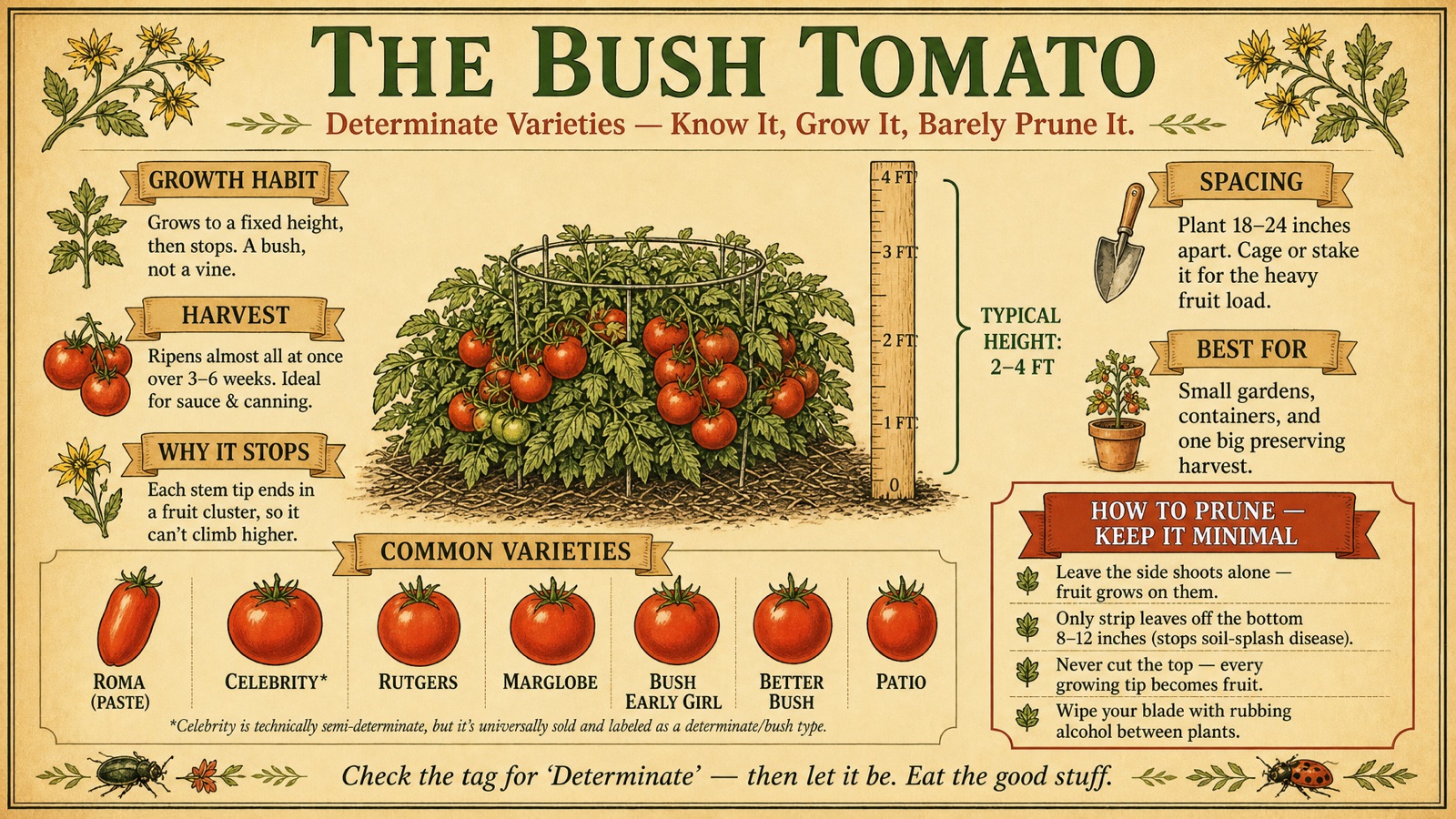
- Bush tomatoes (Determinates): These have a genetically predetermined height. They might grow to 2 to 4 feet, set all of their fruit on the ends of their side shoots, and ripen the entire crop in a window of just 3 to 6 weeks. You barely touch these. Leave the side shoots alone. If you prune them heavily, you are directly cutting away your harvest.
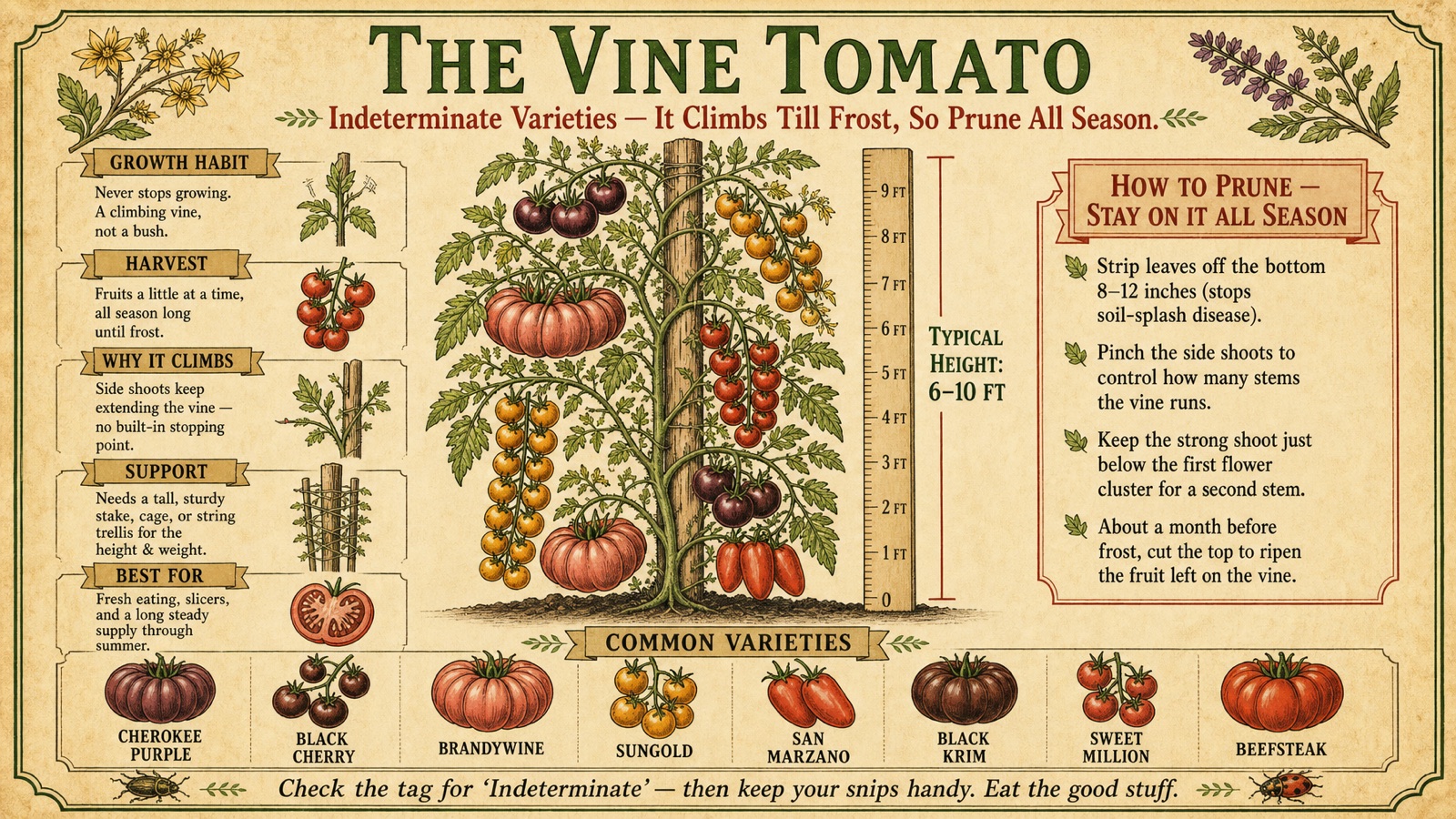
- Vine tomatoes (Indeterminates): These have no genetic off-switch. They will act like climbing vines, typically reaching 6 to 10 feet, and produce a steady supply of fruit until the frost eventually takes them out. This is the plant you go to work on and prune continuously throughout the entire season.
2. Learn the basic tomato anatomy
You don't need a botany degree, but you do need to recognize a few key parts of the plant to prune accurately.
- The Main Stem: The thick central trunk of the plant.
- The Leaves: The branches shooting straight out at 90-degree angles from the main stem. These are the solar panels turning sunlight into sugars for your fruit.
- Fruit Clusters: Clusters of tiny yellow flowers connected along the main stem. If the bees do their job, these become your tomatoes.
- Suckers (Baby Tomato Plants): These sprout in the "armpit" where a leaf connects to the main stem, growing upward at a 45-degree angle.
Most people call that 45-degree shoot a "sucker," but I prefer to call it a baby tomato plant. Why? Because if you leave it alone, it will develop into a massive new branch that produces its own leaves, flowers, and fruit. The real question isn't "should I cut the sucker?" but rather, "do I have the space to let a branch grow in this direction?"
3. Create a disease buffer
This step is non-negotiable for both bush and vine tomatoes. Living soil is full of beneficial biology, but it also houses fungal spores waiting for their moment. Every time it rains or you water your garden, soil splashes up onto the lowest leaves. That splash zone is exactly how early blight and septoria leaf spot take hold and climb your plant.
To stop this, strip every single leaf off the bottom 8 to 12 inches of the main stem, or until you reach the first flower cluster. Cut them completely flush to the stem.
This simple act accomplishes three things at once:
- It eliminates the fungal splash zone.
- It opens up the base for better aerobic airflow.
- It allows the plant to dry out much faster after rain or watering.
Always water the soil, not the leaves. Take away the wet leaves, and you take away the disease.
4. Remove suckers correctly to minimize wounds
When you decide a baby tomato plant needs to go, how you remove it depends entirely on its size.
If the sucker is small (under 2-3 inches), just pinch it off with your fingers. It creates a tiny wound that the plant will heal in a day. However, if the sucker has gotten large and thick, do not try to snap it off by hand. You run a high risk of peeling the skin down the side of the main stem, opening up a massive wound that invites infection. For the big ones, always use sharp pruning shears.
5. Prevent Shear-Transmitted Diseases (STDs)
If you take shears to a diseased plant and then immediately walk over to prune a healthy one, you are just offering a free ride to pathogens.
Keep a bottle of cheap isopropyl alcohol with you in the garden. Wipe down the blades of your shears after every single plant you cut. It only takes five seconds, and it guarantees you won't accidentally propagate diseases across your entire yard.
6. Choose your leader strategy based on spacing
For your indeterminate vine tomatoes, you need to decide how many main branches (leaders) you want to support.
If you have a tiny yard and you are packing your tomatoes tightly into a small space or shallow containers, prune aggressively. Pinch off all the side shoots and train the plant straight up a sturdy stake or string trellis as a single, clean leader.
If you have plenty of room, you might want to let a second leader develop. Research shows that if you want a strong second branch, the best strategy is to keep the strong shoot located directly below the very first flower cluster.
Bonus: Consider your climate (and get free plants)
Pruning isn't just about maximizing fruit; it's also about managing your environment. If you live in a dry, intensely hot climate, you might want to prune lightly to let the extra foliage shade your tomatoes from sunscald. But here in the humid South, my main enemy is stagnant air and moisture. I prune heavily to ensure excellent airflow through the canopy, keeping fungal issues at bay.
And if you end up snipping off a sucker that has already grown past six inches? Don't throw it in the compost. Stick it in a cup of water or directly into some damp potting soil. In a few weeks, that sucker will root and become an exact clone of your original plant. Plant it, or give it away to a neighbor.
Key takeaways
- Always identify if your tomato is a bush (determinate) or a vine (indeterminate) before pruning.
- Strip the bottom 8 to 12 inches of leaves on every tomato plant to stop soil-borne fungal splash.
- Pinch small side shoots by hand; use sterilized shears for large ones to avoid tearing the main stem.
- Sterilize your shears with rubbing alcohol between plants.
- Tailor your canopy density to your climate: leave more leaves for shade in dry heat, and thin aggressively for airflow in high humidity.
Want to see exactly where to make these cuts on a living plant? Watch the full walk-through in the video above. And if you aren't on the Yard Eaters newsletter yet, drop your email below for weekly growing guides, nutrient-density data, and side-by-side comparisons of homegrown vs. grocery-store produce.