Most gardeners who struggle with corn are not failing at growing the plant. Their stalks get tall and green just fine. The problem shows up at harvest, when they peel back the husk and find an ear that is half bare, with a gappy tip and scattered missing kernels. If you want to learn how to grow corn that fills out from base to tip, you have to stop thinking about the stalk and start thinking about pollination and water.
I have been growing food in my Atlanta yard since 2015, and corn taught me a lesson the hard way. A bare ear is almost never a fertilizer problem. It is a pollination problem, a spacing problem, or a water problem, and all three are things you control before the silks ever appear. Here is exactly how to get full ears.
Plant corn in a block, never a row
This is the single biggest mistake I see. Corn is wind-pollinated, which means the pollen falls from the tassels at the top of the plant and has to drift down onto the silks below. If you plant one long single row, most of that pollen blows sideways into the grass and never lands on a neighbor. The result is patchy, half-filled ears.
Plant in a block instead. A block lets each plant catch pollen from the plants all around it.
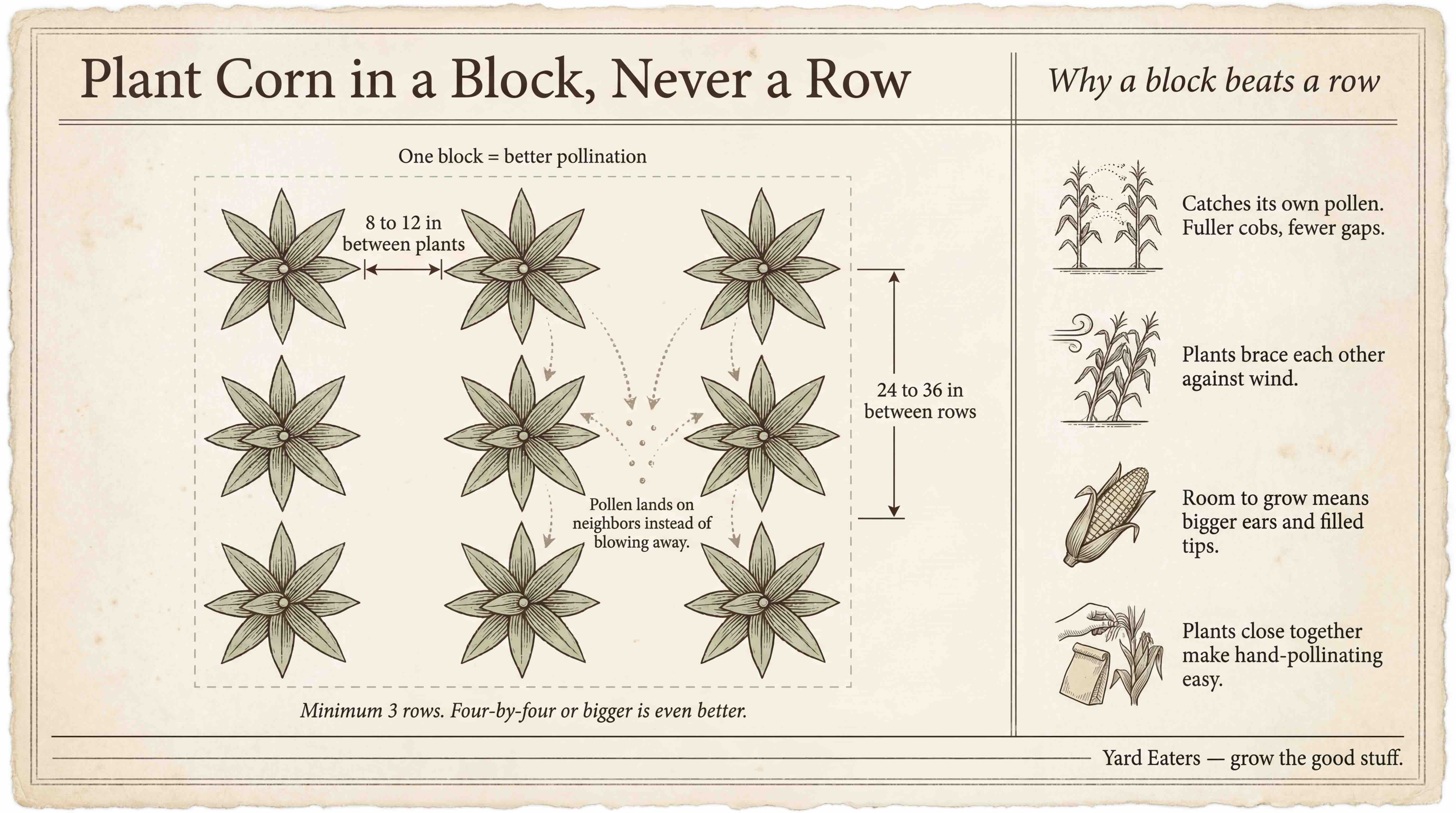
Here is the spacing I use:
- Space plants 8 to 12 inches apart within each row.
- Space rows 24 to 36 inches apart.
- Plant a minimum of 3 rows. A block that is 4 by 4 or bigger is even better.
A block does four things a row cannot. It catches its own pollen, so you get fuller cobs with fewer gaps. The plants brace each other against wind, so fewer stalks topple in a summer storm. The spacing gives each plant enough room to size up bigger ears with filled tips. And planting close together makes hand-pollination easy, which I will cover next.
How corn pollination actually works
To fix bare ears, you need to understand one thing that changes everything: every single silk is one kernel. That strand of silk runs from the outside of the husk all the way down to one spot on the cob. A grain of pollen has to land on that silk, travel down it, and fertilize that one kernel. No pollen on the silk means no kernel in that spot.
Now here is the part almost nobody knows. The silks do not all come out at once.
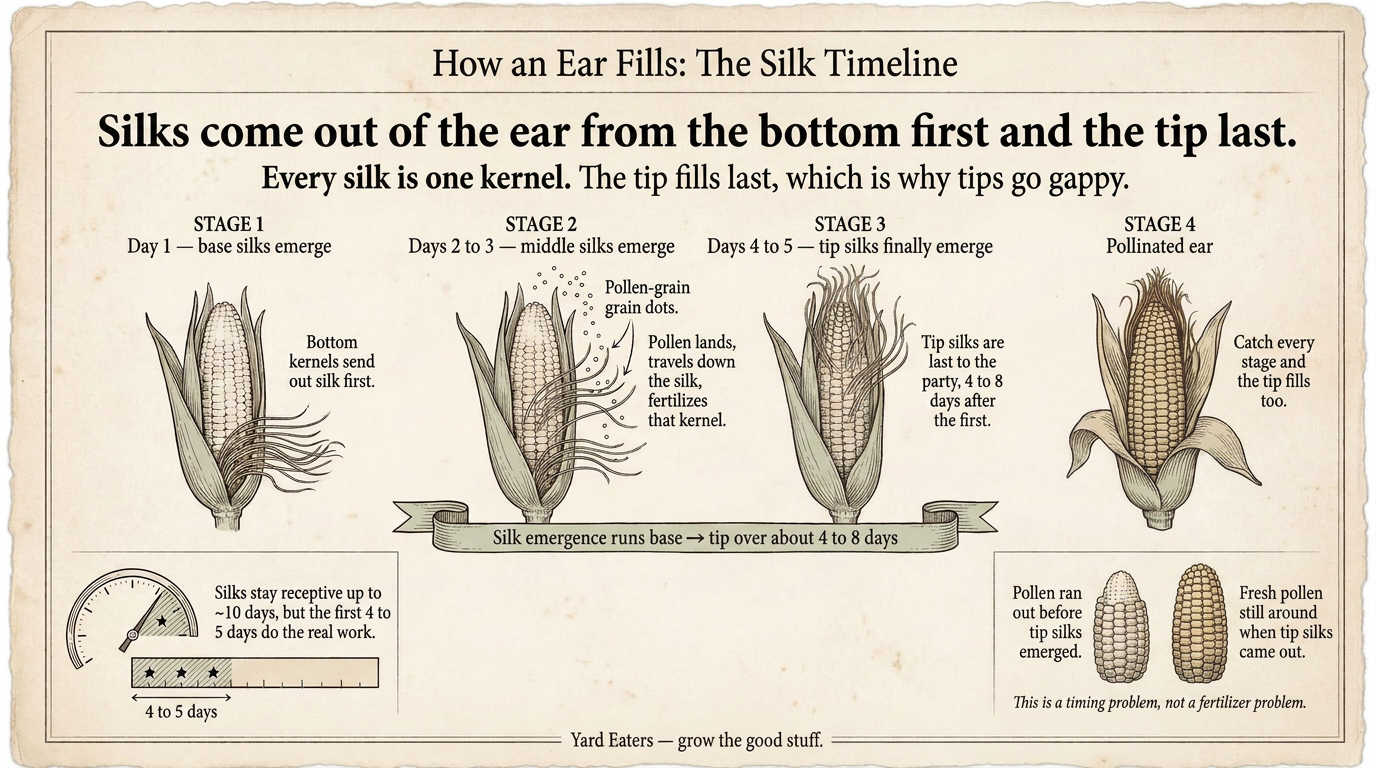
The silks emerge from the bottom of the ear first and work their way up to the tip last, over about 4 to 8 days. The base kernels get pollinated on day one. The tip silks do not even come out until 4 to 8 days later. Silks stay receptive for up to about 10 days, but the first 4 to 5 days do the real work.
This is why tips go gappy. If your plants shed all their pollen in the first few days, there is none left in the air when the tip silks finally emerge. The tip kernels never get fertilized. So a bare tip is a timing problem, not a fertilizer problem. You cannot fix it by feeding the plant. You fix it by making sure pollen is still around when those last silks come out, which is exactly what a dense block and a little hand-pollinating do for you.
Hand-pollinate for completely full ears
In a home garden block, you can guarantee full ears with five minutes of work on a few mornings. This is the highest-leverage thing you can do for corn.
- Wait for the tassels to shed. When you see fine, dusty pollen on the tassels at the top, it is time. Mid-morning is best, after the dew has dried but before the afternoon heat.
- Collect the pollen. Cut a tassel or bend it over a paper bag or cup and tap it. You will see a dusting of yellow pollen collect at the bottom.
- Sprinkle it on the silks. Dust the collected pollen directly onto the silks of every ear. A pinch per ear is plenty.
- Repeat over several mornings. Because the tip silks emerge last, do this every morning for 4 to 5 days. That is how you catch the late tip silks and fill the ear all the way up.
When to water corn: the make-or-break window
Corn will forgive uneven watering for most of its life. There is one window where it will not, and getting this wrong is how a lot of gardens end up with poor ears despite doing everything else right.
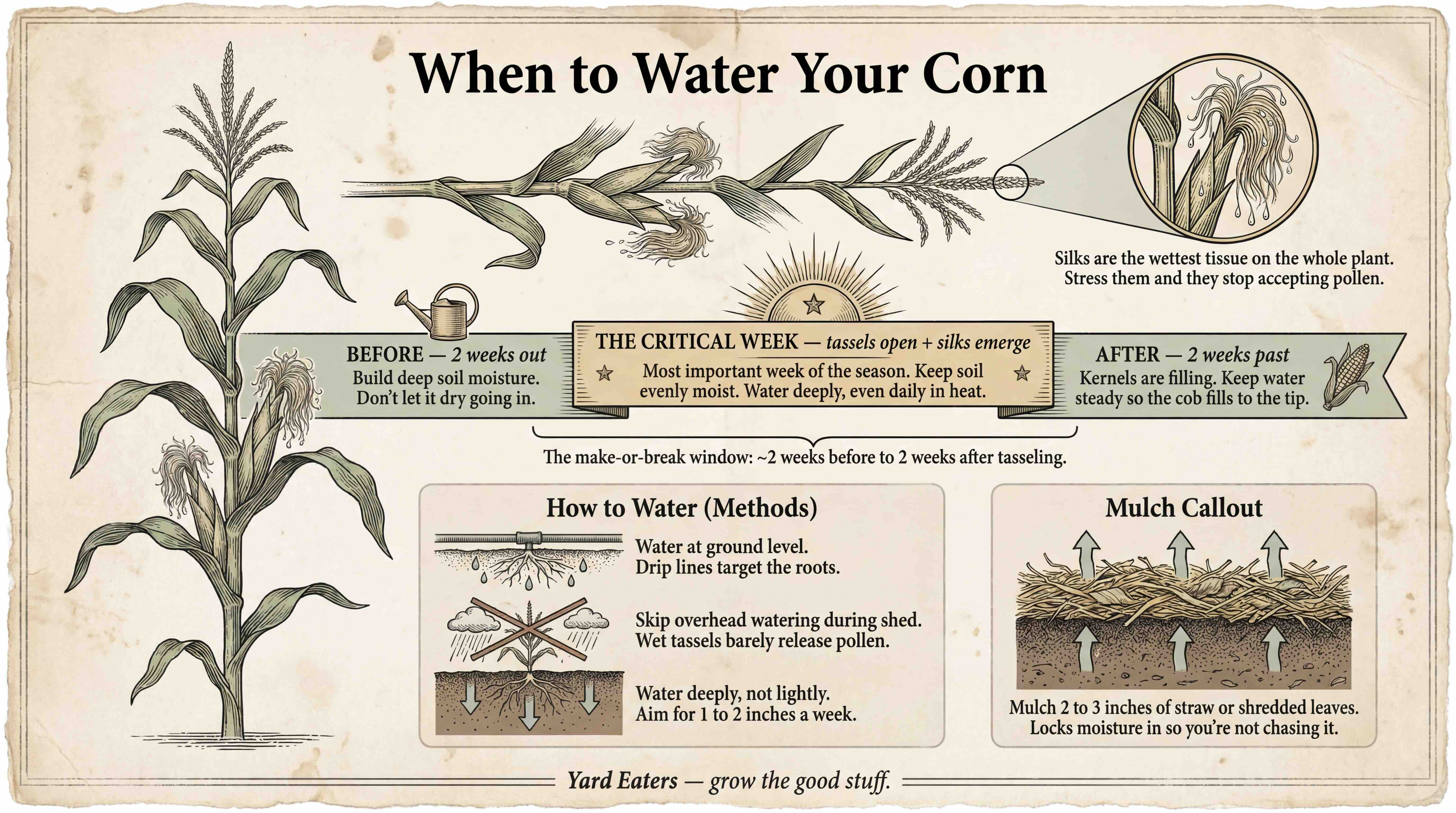
The critical window runs from about 2 weeks before to 2 weeks after tasseling, which is when the tassels open and the silks emerge. The silks are the wettest tissue on the entire plant. If you stress them for water, they stop accepting pollen, and no amount of pollen in the air will save the ear. Here is how to think about the three phases:
- Before, about 2 weeks out. Build deep soil moisture. Do not let the bed dry out heading into tasseling.
- The critical week, tassels open and silks emerge. This is the most important week of the season. Keep the soil evenly moist. Water deeply, even daily in real heat.
- After, about 2 weeks past. The kernels are filling. Keep water steady so the cob fills all the way to the tip.
A few rules on how to water:
- Water at ground level. Drip lines target the roots, right where the plant needs it.
- Skip overhead watering while the tassels are shedding. Wet tassels barely release pollen, so a sprinkler during pollen shed works against you.
- Water deeply, not lightly. Aim for 1 to 2 inches a week.
- Mulch. Lay 2 to 3 inches of straw or shredded leaves. It locks moisture in so you are not chasing the soil with a hose every day.
Key takeaways
- Plant corn in a block of at least 3 rows, not a single row, so it pollinates itself. Space plants 8 to 12 inches apart and rows 24 to 36 inches apart.
- Every silk is one kernel. Silks emerge from the base first and the tip last over 4 to 8 days, which is why tips fill last.
- A bare or gappy tip is a timing problem, not a fertilizer problem. Pollen ran out before the tip silks emerged.
- Hand-pollinate over several mornings to guarantee full ears, collecting pollen from the tassels and dusting it on the silks.
- Water is make-or-break from about 2 weeks before to 2 weeks after tasseling. Keep the soil evenly moist, water deeply at ground level, and mulch to hold it.
Get the block, the pollination, and that two-week water window right, and you will pull full, heavy ears that fill to the tip. Watch the full walk-through in the video above, and join the newsletter below for weekly growing guides and real data from my Atlanta yard.